Blog
Kiwi Basil Seed Drink Gains Ground in Sustainable Beverage Market
Oct
The kiwi basil seed drink is drawing closer attention from importers and retail buyers as packaging choices, sourcing transparency, and formulation credentials move to the center of beverage purchasing decisions worldwide. Trobest’s 290ml glass bottle variant sits at a commercial crossroads: it answers growing demand for recyclable, premium-feeling packaging while delivering the visual texture and flavor differentiation that seed-based beverages need to hold shelf space against conventional fruit nectars.
The wider drinks industry is recalibrating at the same time. Alcohol-free specialist Sentia Spirits has pushed GABA-powered drinks into new channels, Carlsberg is using acquisitions to deepen its PepsiCo distribution partnership, and Diageo continues to manage operational pressure at Cameronbridge while Castel’s leadership retains board support through a contested court ruling. Southern Glazer’s settlement of its Federal Trade Commission pricing dispute with retailers adds another reminder that commercial rules are tightening across the sector. Against that backdrop, manufacturers able to demonstrate certification coverage, export volume, and packaging responsibility are being prioritized in supplier reviews.
Key Takeaways
- Seed-based beverages are expanding from specialty counters into mainstream retail, and kiwi flavor variants are among the most visible additions to buyer portfolios.
- The 290ml glass bottle format used for Trobest’s kiwi basil seed drink supports recyclability expectations in Europe, the Americas, and other regulated import markets.
- Certification portfolios — HACCP, ISO, GMP, FSSC 22000, BRC, Halal Jakim, Halal HCA-GCC, Kosher, and SMETA — now function as qualification gates rather than differentiators.
- RITA Food & Drink Co., Ltd., operating since 2004 with exports to more than 100 countries and territories, anchors Trobest’s OEM and ODM capacity for private-label buyers.
- Seed drinks compete with a broader wave of alcohol-free and reformulated beverage launches, which makes packaging and positioning decisions commercially decisive.
Why the Kiwi Basil Seed Drink Is Winning Global Retail Attention
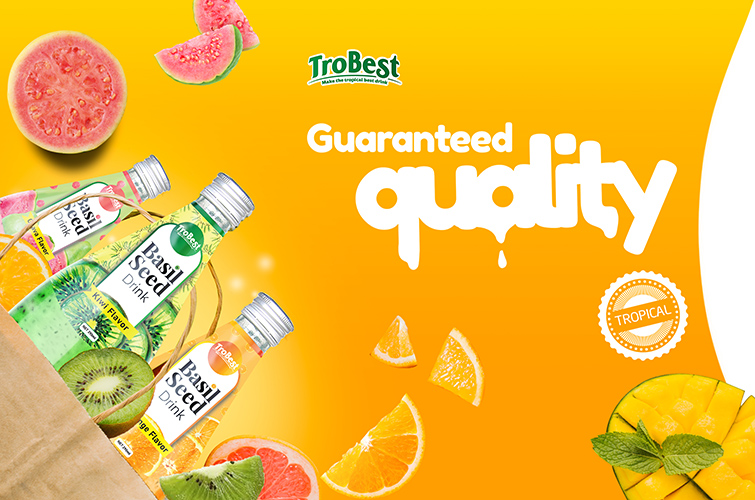
Seed beverages have moved quickly from niche wellness shelves into mainstream grocery aisles. Basil seeds, known in various markets as Sabja or Tukmaria, now appear in ready-to-drink formats paired with familiar flavors such as mango, lychee, coconut, and kiwi. For buyers, the category offers differentiation that a crowded juice or soft-drink set struggles to replicate — a product that looks different, reads differently on a shelf tag, and carries a flavor story consumers already understand.
The basil seed drink category also benefits from broader consumption shifts rather than one-off fashion. Across Asia, Europe, the Americas, the Middle East, Africa, and Oceania, retailers are refreshing beverage assortments to include products that pair distinctive flavor with credible packaging narratives. A seed drink packaged in clear glass offers both: visible product character and a format that importers can position within sustainability-led retail programs without re-engineering their supply chain.
Flavor, Format, and What Buyers Expect Visually
Kiwi works particularly well as a seed drink flavor. Its aromatic, slightly tart profile cuts through the mild, gently nutty character of hydrated basil seeds, producing a drink that reads as fresh rather than overly sweet. That balance matters commercially. Buyers in distribution meetings increasingly reference appearance and flavor clarity when shortlisting seed drink launches, and kiwi delivers both in a single format.
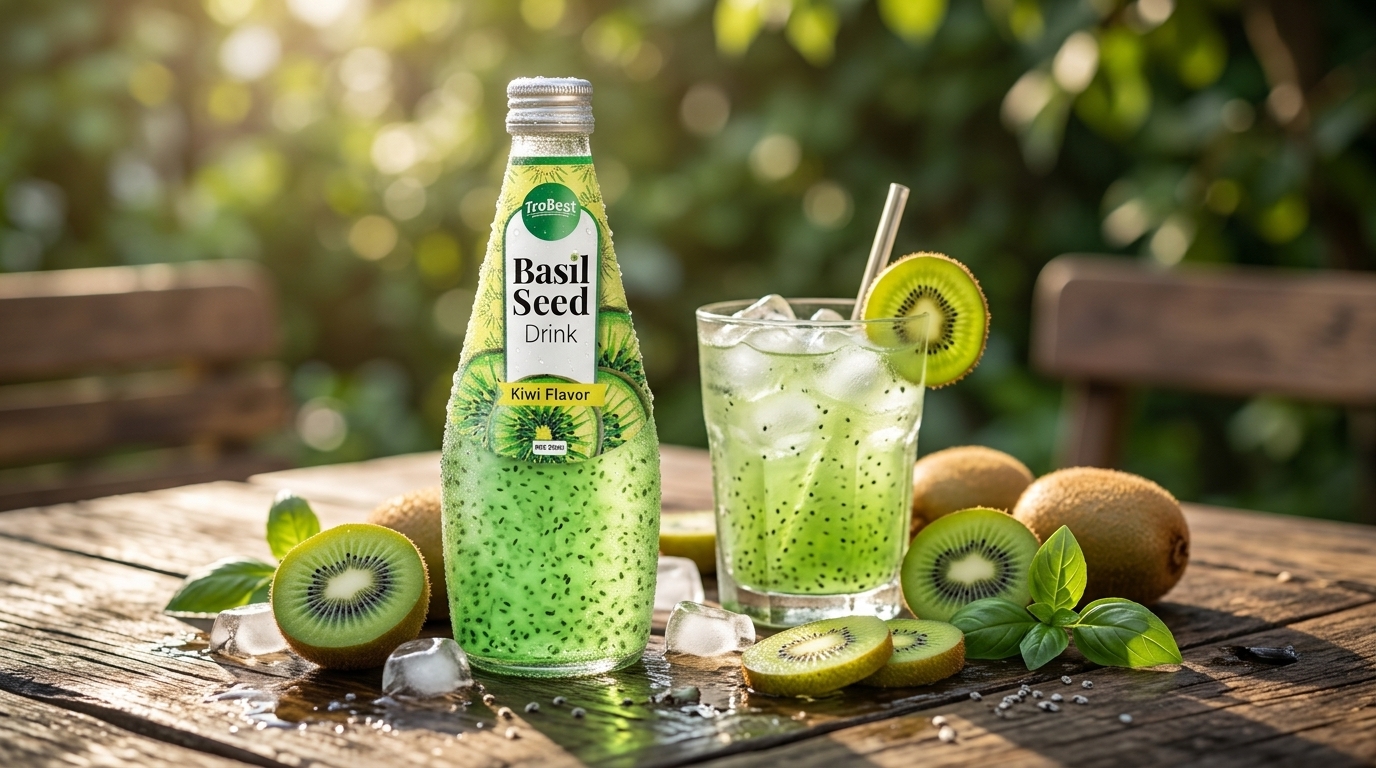
The 290ml glass bottle amplifies that presentation. The vivid green liquid with suspended black basil seeds remains fully visible through clear glass, giving consumers an immediate cue about what they are buying before they read the label. The bottle’s silver cap and green-and-yellow label design — with sliced kiwi illustrations — complete a shelf presence that supports placement in premium or specialty tiers rather than commodity beverage rows.
Glass Packaging and the Sustainability Calculation
Packaging responsibility is now a purchasing criterion, and the kiwi basil seed drink in a 290ml glass bottle was clearly selected with that in mind. Glass remains one of the few widely accepted recyclable beverage containers in global collection systems, and it does not lose value after recycling in the way some plastics do.
For importers in Europe and North America responding to extended producer responsibility schemes, recycled-content mandates, and retailer-level sustainability scorecards, a glass-packaged seed drink simplifies compliance conversations. It also fits the premium tier that grocery chains are carving out for better-packaged beverage lines — a category where glass performs consistently in consumer perception surveys across multiple markets.
From Packaging Choice to Shelf Performance
Shelf performance remains the practical test that sustainability credentials alone do not pass. Glass provides barrier properties that protect color and flavor during extended warehousing and container shipping, which is decisive for orders moving from Vietnamese production to distribution hubs across six continents. It also supports premium pricing tiers, an important margin consideration for private-label partners working in price-sensitive import markets.
Glass does carry weight and freight-cost implications, so buyers comparing case configurations need suppliers who can discuss alternative formats openly. Trobest’s portfolio spans multiple bottle, pouch, and can options, giving importers room to align format choice with route economics rather than accepting a single specification. That flexibility is one of the reasons seed drink orders from the brand are appearing in both premium retail lanes and high-volume distribution agreements.
Certification Coverage and Export Credentials
Export buyers now treat certification lists as risk assessments rather than marketing copy. The Trobest brand, manufactured by RITA Food & Drink Co., Ltd. in Vietnam, carries a portfolio that includes HACCP, ISO, GMP, FSSC 22000, BRC, Halal Jakim, Halal HCA-GCC, Kosher, and SMETA — documentation sets that cover the requirements of halal distributors, kosher retail chains, and European social-compliance auditors in one framework.
For the kiwi basil seed drink in a 290ml glass bottle, that coverage is what turns a well-conceived product into an exportable SKU. Buyers in the Middle East and North Africa typically require halal certification at both ingredient and facility level. European importers prioritize FSSC 22000 and SMETA documentation. North American grocery chains increasingly request BRC or another GFSI-benchmarked accreditation. Holding all of these shortens supplier qualification cycles considerably.
RITA Food & Drink Co., Ltd. has operated in the beverage export space since 2004, and its footprint of more than 100 countries and territories provides reference volume for buyers conducting due diligence. The company’s ODM capability — where formulation, packaging artwork, and bottle specifications are developed for the buyer — has proven especially relevant to private-label programs targeting Asia-Pacific retail chains and European specialty importers. Details of the manufacturing and certification background are available through the RITA Food & Drink about page.
Category Context and Competitive Positioning
Seed drinks do not compete in isolation. The broader beverages sector has seen sustained reformulation activity, consolidation among major brewers, and a wave of alcohol-free launches aimed at consumers stepping away from traditional spirits. All of that shapes how a seed drink is presented to buyers evaluating new SKU slots.
| Segment | Typical Packaging | Retail Positioning | Transport Profile |
|---|---|---|---|
| Kiwi basil seed drink, 290ml glass bottle | Glass bottle | Premium seed beverage | Extended shelf life, ambient shipping |
| Conventional fruit juice | PET bottle, Tetra Pak | Mainstream refreshment | Often cold-chain dependent |
| Carbonated soft drink | Aluminum can, PET | Impulse purchase | Ambient, long-dated |
| Alcohol-free functional drink | Glass bottle, can | Specialty wellness channel | Variable by formulation |
Against that comparison, the kiwi basil seed drink occupies a commercially efficient middle ground. It carries the visual and ingredient differentiation of a specialty product while retaining the shelf-life and logistics characteristics of mainstream packaged drinks. Buyers looking to step away from crowded juice, tea, or energy categories often find that combination easier to place at retail and easier to explain to consumers already accustomed to seeded beverages.
Basil Seed Sourcing and Formulation Consistency
Basil seeds demand careful handling to deliver the suspension, texture, and flavor integration consumers expect from a finished drink. Hydration characteristics, seed grading, and integration with kiwi flavoring all affect the final product, which makes raw-material relationships a practical part of supplier evaluation rather than an abstract sourcing claim.
Manufacturers drawing from established chia and basil seed supply portfolios can maintain consistency across production runs — the single most important factor behind repeat orders. For the Trobest kiwi basil seed drink, that consistency is reflected in the visible seed distribution within the bright green liquid, a detail retail buyers inspect closely during product presentations.
Formulation flexibility matters just as much. Importers targeting different price points often request seed ratios, sweetness levels, and flavor intensities adjusted to local preferences. The full product specification for the kiwi basil seed drink provides buyers with the baseline data needed to begin those discussions, while RITA’s broader basil and chia seed drinks catalog covers the wider formulation range available for private-label development. Buyers exploring adjacent categories will also find relevant options across the manufacturer’s fruit juice product lines.
Business Opportunities for Private-Label and OEM Buyers
Private-label demand is where seed drink exports have accelerated most quickly. Importers across the Middle East, Africa, and Oceania are seeking suppliers who can deliver ready-to-drink basil seed formulations with custom flavor profiles, label artwork, and bottle specifications under OEM or ODM arrangements — and who can do so without weakening their certification position.
For distributors evaluating suppliers, the practical checklist has grown more demanding: halal and kosher options, FSSC 22000 or BRC food-safety certification, SMETA social-compliance documentation, and demonstrated export volume into the buyer’s target region. A seed drink manufacturer able to satisfy those criteria at competitive pricing gains a clear advantage in multi-country tender processes.
Those requirements align closely with Trobest’s operating model. The brand’s manufacturing base, run by RITA Food & Drink Co., Ltd., combines formulation flexibility with the certification breadth international buyers now expect, and its presence in more than 100 export markets gives prospective private-label partners concrete references for route planning and volume discussion.
Outlook for the Kiwi Basil Seed Drink Category
The kiwi basil seed drink appears positioned for steady category growth rather than a short spike. Retailers across six continents are expanding beverage sets to include seed-based, better-packaged, and longer-dated options — a combination this format satisfies without requiring the category-education investment that newer functional launches demand.
For importers and private-label partners, the current window favors suppliers who combine formulation stability, credible certifications, flexible packaging programs, and documented export volume. That is the operational profile Trobest has built around its 290ml glass bottle kiwi basil seed drink and the broader seed drink portfolio manufactured by RITA Food & Drink Co., Ltd.
Frequently Asked Questions
What is the Trobest 290ml kiwi basil seed drink?
It is a ready-to-drink basil seed beverage with kiwi flavoring, manufactured by Trobest and produced under RITA Food & Drink Co., Ltd. in Vietnam. The product is supplied in a 290ml clear glass bottle with a silver cap, presenting bright green liquid with visible basil seeds suspended throughout.
Why is glass used for this seed drink format?
Glass supports recyclability expectations in regulated import markets, protects flavor and color during extended warehousing and container shipping, and presents the product’s color and suspended seeds to the consumer. It also helps the product sit within premium retail tiers where better-packaged beverages are positioned.
Which certifications cover the kiwi basil seed drink for export?
The manufacturing framework behind the Trobest brand includes HACCP, ISO, GMP, FSSC 22000, BRC, Halal Jakim, Halal HCA-GCC, Kosher, and SMETA. These certifications address halal and kosher distribution requirements as well as European and North American food-safety and social-compliance audits.
Is the kiwi basil seed drink available for OEM and private-label production?
Yes. RITA Food & Drink Co., Ltd. has provided OEM and ODM services since 2004, covering formulation, packaging, and label development. Buyers can request adjusted flavor profiles, bottle specifications, and case configurations for their target markets.
