
Blog
Mango Dragon Fruit Bubble Tea Innovates the Global Canned Tea Market
Oct
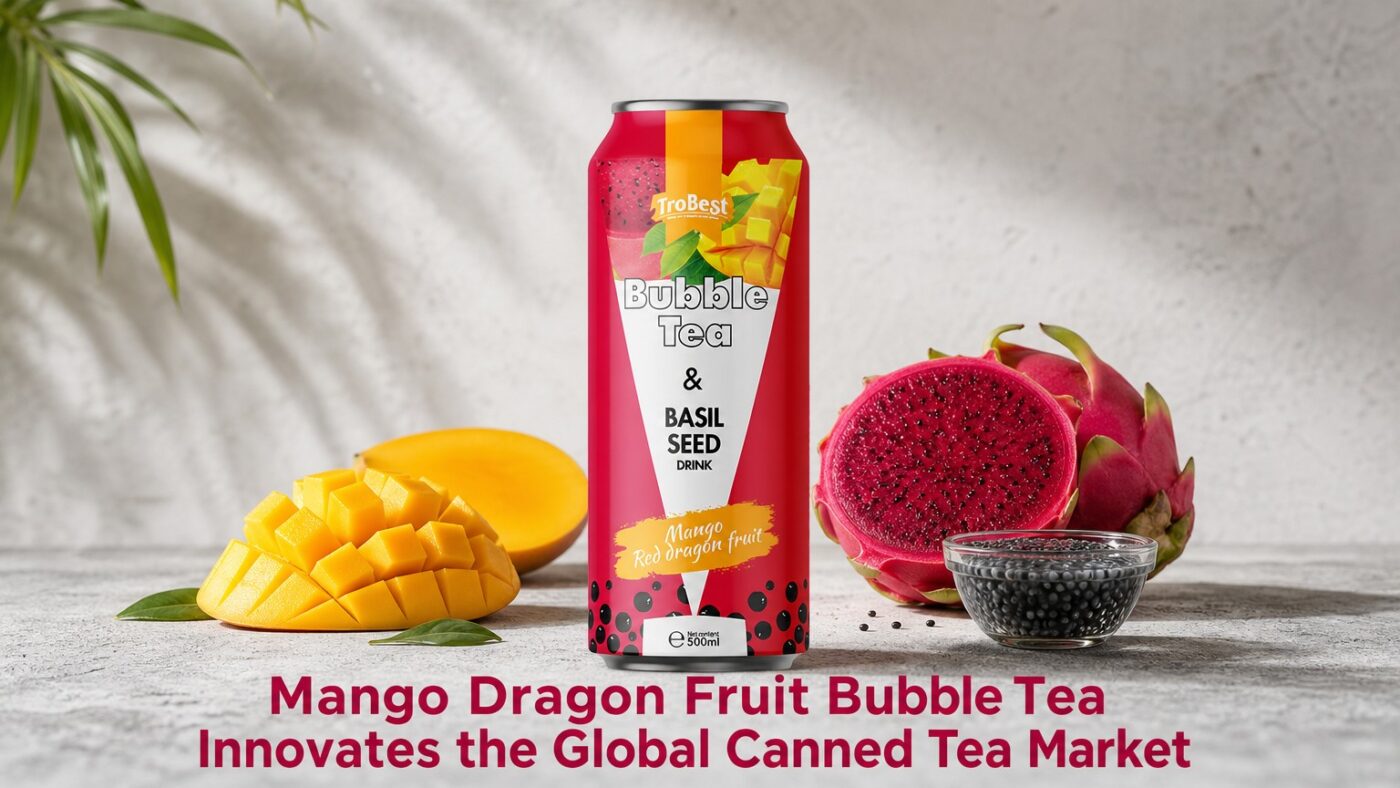
Trobest, the premium beverage brand under Vietnam’s RITA Food & Drink Co., Ltd., has launched a mango dragon fruit bubble tea in a 500ml aluminum can, pairing the global bubble tea trend with tropical flavors and export-ready packaging. The product blends red dragon fruit juice, mango juice, black tea leaves, basil seeds, tapioca pearls, non-dairy creamer, and whole milk powder into a single-serve format engineered for distribution across more than 100 countries.
Ready-to-drink bubble tea is one of the fastest-moving categories in the international tea beverage market, and canned formats are increasingly the format of choice for manufacturers targeting cross-border growth. Trobest’s latest release positions the company at the intersection of convenience-driven consumer demand, tropical ingredient sourcing, and certified manufacturing — a combination that resonates with importers and distributors seeking scalable, shelf-stable products for diverse retail environments.
Key Takeaways
- Trobest has launched a 500ml mango dragon fruit bubble tea in aluminum cans targeting global export markets.
- The formulation combines mango juice, red dragon fruit juice, black tea, basil seeds, tapioca pearls, and non-dairy creamer.
- Manufacturing follows internationally recognized standards including HACCP, ISO, GMP, FSSC 22000, BRC, Halal, and SMETA.
- RITA Food & Drink Co., Ltd., Trobest’s parent company, exports to 100+ countries and provides OEM and ODM services.
- The canned bubble tea format addresses scalability, portability, and logistics challenges in international beverage distribution.
Why Canned Bubble Tea Represents a Strategic Innovation Opportunity
The category is still young, and that is precisely what makes it strategically interesting for manufacturers and importers alike.
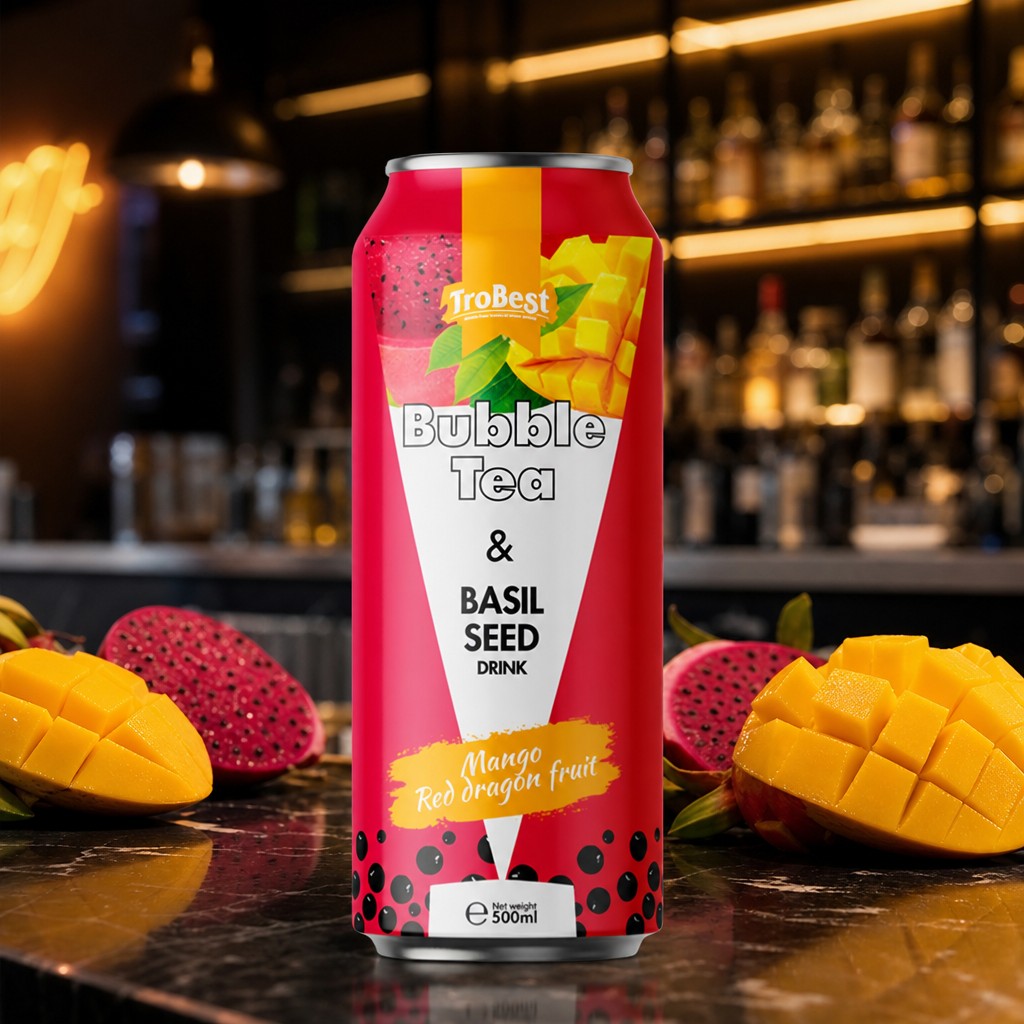
Bubble tea’s rapid global expansion has shifted its center of gravity from made-to-order preparation toward packaged formats that move through existing retail and e-commerce channels. Canned bubble tea removes the operational friction that has historically limited bubble tea’s reach beyond its original Asian markets — no blenders, no refrigeration, and no trained staff required at point of sale. For manufacturers, this translates into the ability to produce at scale, ship internationally, and store on retail shelves for extended periods without degrading the consumer drink experience.
The choice of mango and red dragon fruit as primary flavor components reflects a deliberate market strategy. Mango is one of the most universally recognized tropical fruits, with robust consumer demand across the Americas, Europe, the Middle East, and Asia-Pacific. Red dragon fruit introduces a visually striking element — its vivid magenta-red flesh creates an eye-catching color contrast in the drink and on shelf packaging, an important advantage in a category where visual appeal drives consumer discovery on both physical shelves and digital marketplaces.
Packaging That Travels Well Across Borders
Aluminum can packaging is central to Trobest’s international distribution strategy for this product line.
The 500ml aluminum can format offers several practical advantages for global supply chains. It is significantly lighter than glass alternatives, which reduces freight costs per unit in international shipping. Aluminum is infinitely recyclable, which matters for importers operating under extended producer responsibility regulations in the European Union and other markets. The can also provides an effective barrier against light and oxygen, protecting the flavor integrity of the tea and fruit juice blend during transit and storage. For retail buyers, the format stacks efficiently on standard shelving, fits palletized shipping configurations, and carries a low breakage risk compared to glass or flexible pouch alternatives.
Buyers interested in Trobest’s broader tea beverage offerings can review the Trobest tea drink product catalog, which includes a range of flavored tea beverages developed for both retail and food-service distribution across international markets.
Product Composition of the Mango Dragon Fruit Bubble Tea
The formulation layers tea, fruit, and textural elements into a single drink that captures the full bubble tea experience in a portable format.
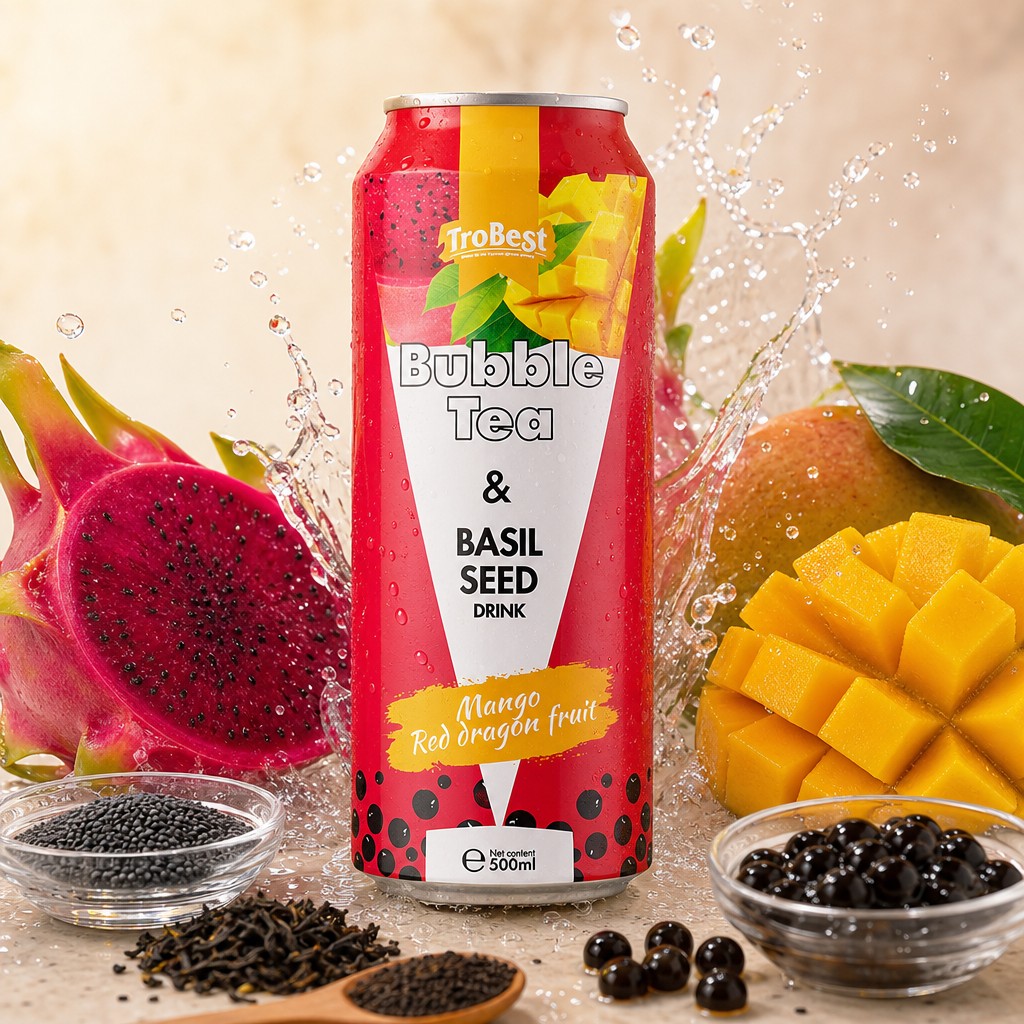
Ingredient Profile of the Mango Dragon Fruit Bubble Tea
Trobest’s mango dragon fruit bubble tea is built around a layered flavor architecture that balances tea, tropical fruit, and textural components.
Black tea leaves form the beverage’s foundation, providing the characteristic tea flavor that defines the bubble tea category. Mango juice and red dragon fruit juice contribute sweetness and tropical character, while basil seeds add a distinctive visual dimension — they swell when hydrated and suspend within the liquid, creating the seed-speckled appearance that has become a signature trait of Asian seed-drink beverages. Tapioca pearls complete the bubble tea identity, delivering the chewy, pearl-like texture that consumers associate with the category. Non-dairy creamer and whole milk powder provide a smooth, creamy mouthfeel that balances the natural acidity of the fruit juices.
Basil seeds have emerged as a notable ingredient trend across Asian, Middle Eastern, and African beverage markets. Trobest’s parent company maintains a dedicated chia and basil seed drink portfolio that reflects growing demand for seed-based beverages across multiple product formats, flavor profiles, and packaging types.
What Sets the Mango Dragon Fruit Bubble Tea Apart
Several design decisions differentiate this product from generic canned tea beverages on the market.
First, the dual-fruit formulation — mango and red dragon fruit — provides a flavor profile that is both familiar and distinctive. Mango anchors the drink in a flavor that consumers worldwide already recognize, while red dragon fruit adds novelty and visual differentiation. Second, the inclusion of both tapioca pearls and basil seeds in a canned format addresses a consumer expectation gap: many canned bubble tea products omit the textural elements that define the category. Third, the 500ml volume positions the product for single-serve consumption occasions — convenience retail, food-service, and e-commerce — rather than multi-serve household purchase patterns.
From Vietnam’s Orchards to the Aluminum Can — Sourcing the Raw Materials
Trobest’s supply chain for tropical raw materials extends from farm-level sourcing through finished beverage production, with traceability built into each stage.
The mango component draws on Vietnam’s established tropical fruit production base, where the company’s parent organization maintains direct relationships with growing regions. The journey from orchard to juice extraction is documented and monitored, providing buyers with supply chain transparency that is increasingly required by major retail and food-service procurement teams. The company’s mango farm sourcing process illustrates how raw material quality is tracked from field-level harvesting through to the juice used in finished beverage products.
The red dragon fruit component follows a parallel sourcing model rooted in one of Vietnam’s most productive growing regions. Binh Thuan province, located in southern Vietnam, is a major hub for dragon fruit cultivation, and the company maintains a documented dragon fruit raw material area in Binh Thuan that supports year-round juice supply planning for beverage manufacturing.
For a closer look at the dragon fruit growing environment and supply chain operations, a farm visit video is available at https://www.youtube.com/watch?v=ZoRFRhI6Nsg
Export Markets and Global Positioning
Vietnam’s beverage export sector continues to expand, and canned tropical beverages — including bubble tea — are part of that growth trajectory.
Trade Flows and Regional Demand Patterns
The global ready-to-drink tea market remains in a growth phase, with Southeast Asia serving as both a major production base and an increasingly significant consumption region.
RITA Food & Drink Co., Ltd., the parent company behind Trobest, operates an export network covering more than 100 countries and territories across Asia, Europe, the Americas, the Middle East, Africa, and Oceania. This geographic breadth positions the company to respond to demand signals across multiple markets simultaneously — a capability that smaller regional manufacturers often lack. The company has also built a substantial private-label manufacturing business, offering OEM and ODM services to distributors and retailers who want branded or custom-formulated tropical beverages without investing in their own production infrastructure. Trobest beverages are manufactured in Vietnam under certified conditions that meet the regulatory requirements of diverse import markets.
For businesses exploring contract manufacturing options in the tropical beverage space, the company’s OEM beverage manufacturing service provides full-cycle support from product formulation through packaging design and export logistics, enabling brands to enter new markets with proven manufacturing partners.
Industry Context — Where Bubble Tea Fits in the Beverage Sector’s Evolution
Recent developments across the broader beverage industry offer a useful backdrop for understanding the strategic logic behind canned bubble tea innovation.
Major global beverage companies are navigating a period of operational complexity and portfolio optimization. Diageo, the world’s largest spirits producer, has faced labor disputes at its Cameronbridge distillery in Scotland while simultaneously seeing a US tequila lawsuit dismissed — developments that illustrate the regulatory and labor pressures affecting large-scale beverage manufacturers. The company also confirmed the closure of its Guinness Open Gate brewing site, signaling consolidation trends in craft-adjacent operations. Elsewhere, Scottish spirits producer Holyrood has paused production entirely, and Australian Vintage has moved to sell its Nepenthe cellar door and vineyard assets as part of a broader restructuring of its wine business.
These developments collectively point to a clear pattern: established beverage companies are being pushed to optimize portfolios, prioritize scalable formats, and find growth in categories that require lower operational overhead and offer faster time-to-market. Canned tropical beverages — including the mango dragon fruit bubble tea format — sit squarely within this strategic direction. They offer manufacturers a path to reach consumers in new geographies without the capital intensity of fresh-prepared drink infrastructure, and they align with retail channels that value shelf stability, extended product life, and efficient logistics.
Certifications and Quality Infrastructure
Export-facing beverage manufacturers must navigate a complex web of regulatory, safety, and ethical requirements across different markets and buyer categories.
Trobest’s manufacturing operations hold certifications across multiple internationally recognized frameworks:
- BRC — British Retail Consortium Global Standards for food safety and quality
- FSSC 22000 — Food Safety System Certification, recognized globally by major retail chains
- Halal Jakim and Halal HCA-GCC — Halal certifications enabling distribution across the Middle East, North Africa, and Southeast Asia
- Kosher — Certification supporting distribution in North American, European, and Israeli markets
- ISO and GMP — International quality management and Good Manufacturing Practice standards
- HACCP — Hazard Analysis and Critical Control Points food safety system
- SMETA — Sedex Members Ethical Trade Audit, addressing supply chain transparency and labor practice requirements
These certifications function as market-access enablers rather than mere compliance checkpoints. Halal certification unlocks distribution channels across the Middle East and Muslim-majority markets. BRC and FSSC 22000 certifications are increasingly required by major retail chains in Europe, North America, and the Asia-Pacific region. Kosher certification broadens appeal in specific consumer segments. SMETA certification addresses growing procurement requirements around ethical labor practices and supply chain visibility — a factor that has become a standard requirement for many international retail and food-service organizations.
Product Information for Buyers and Distributors
Full product specifications, ingredient details, and packaging information for this product are available on the official Trobest product page for the 500ml Mango Dragon Fruit Bubble Tea.
The page includes the complete ingredient list, packaging format, volume specifications, and export documentation needed for import planning and distribution channel development. The 500ml bubble tea product listing on Trobest’s website is part of a broader catalog covering fruit juices, coconut beverages, tea drinks, seed beverages, and other tropical formats — all manufactured in Vietnam for global export.
For businesses interested in developing custom tropical beverage products for private-label distribution, the Trobest Mango Dragon Fruit Bubble Tea product page serves as the starting point for discussions around OEM formulation, packaging customization, and market entry planning for new export destinations.
Frequently Asked Questions
What is Trobest’s Mango Dragon Fruit Bubble Tea?
Trobest’s Mango Dragon Fruit Bubble Tea is a 500ml canned bubble tea beverage combining mango juice, red dragon fruit juice, black tea leaves, basil seeds, tapioca pearls, non-dairy creamer, and whole milk powder. It is manufactured in Vietnam by RITA Food & Drink Co., Ltd. and exported to markets worldwide.
What certifications does the product carry?
The product is manufactured under internationally recognized quality and safety frameworks including HACCP, ISO, GMP, FSSC 22000, BRC, Halal Jakim, Halal HCA-GCC, Kosher, and SMETA certifications.
What markets does Trobest export to?
Trobest exports to more than 100 countries and territories across Asia, Europe, the Americas, the Middle East, Africa, and Oceania. The company also offers OEM and ODM manufacturing services for private-label tropical beverage products.
What packaging format does the bubble tea come in?
The product is packaged in a 500ml aluminum can, which is lightweight, recyclable, and compatible with standard retail shelving and palletized shipping in most international markets.
Can Trobest develop custom bubble tea flavors for private-label brands?
Yes. RITA Food & Drink Co., Ltd. provides OEM and ODM services, allowing distributors and retailers to develop custom formulations, flavors, and packaging for bubble tea and other tropical beverage products.
