Blog
Regulatory Compliance Shapes Premium Basil Seed Drink Export Strategy
Nov
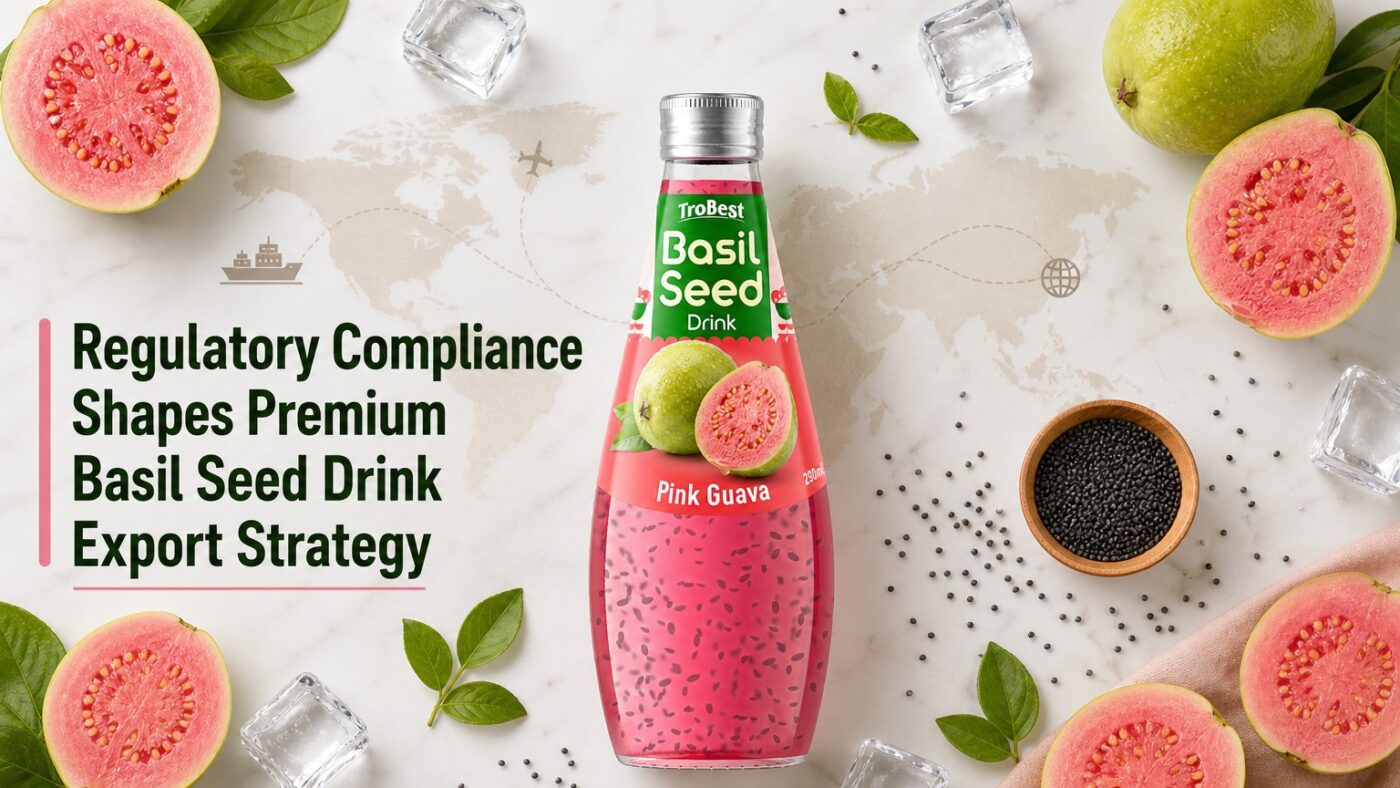
The global ready-to-drink beverage market is undergoing a quiet but decisive shift as regulatory frameworks across continents tighten their grip on labeling, ingredient transparency, and food safety certification. For exporters of premium tropical beverages, compliance is no longer a checkbox on a shipping manifest — it is a competitive differentiator that determines shelf access, retail listing eligibility, and long-term distributor relationships. Within this evolving landscape, the 290ml Glass Bottle Basil Seed Drink with Pink Guava from Trobest exemplifies how a single product SKU can embody a comprehensive regulatory strategy, pairing clean-label formulation with a portfolio of internationally recognized certifications that open doors in dozens of jurisdictions.
Key Takeaways
- Regulatory harmonization across major import markets is raising the bar for beverage exporters, making multi-standard certification a commercial necessity rather than a luxury.
- Glass packaging and clean-label formulations are gaining favor among regulators and premium retailers evaluating imported beverages for shelf placement.
- Vietnamese beverage manufacturers are leveraging decades of export experience and broad certification portfolios to compete in highly regulated markets worldwide.
- Private-label and OEM programs allow buyers to tailor compliant products to specific jurisdictional requirements without building manufacturing capacity from scratch.
- Long shelf life combined with stable packaging materials simplifies customs clearance and distribution logistics for B2B partners.
Regulatory Landscape Reshaping Global Beverage Trade
Import regulators from the Americas to Oceania are converging on stricter documentation requirements for packaged beverages, and the pace of change is accelerating.
Food safety authorities in Europe, the Middle East, and Asia-Pacific have in recent years expanded their scrutiny of imported ready-to-drink products, demanding detailed ingredient declarations, allergen statements, and traceability records that go well beyond basic customs paperwork. Halal certification has become a de facto requirement for entry into many markets in the Middle East and Southeast Asia, while Kosher credentials unlock distribution through specialized retail channels in North America and Europe. For a manufacturer exporting to more than 100 countries and territories, maintaining simultaneous compliance with BRC, FSSC 22000, ISO, GMP, HACCP, and SMETA standards is an operational discipline that shapes everything from raw material sourcing to final carton sealing. The regulatory angle matters commercially: buyers increasingly shortlist suppliers based on certification breadth before they ever evaluate price or flavor profile.
The 290ml Glass Bottle Basil Seed Drink with Pink Guava arrives on the market already aligned with this multi-jurisdiction reality, giving importers a head start on compliance documentation.
Why Certification Stacks Matter to Buyers
A single certificate rarely satisfies the full range of requirements an exporter faces across diverse markets.
Consider the practical scenario of a distributor serving both a European hypermarket chain and a Gulf Cooperation Council wholesale network. The European buyer will expect FSSC 22000 or BRC evidence alongside full EU ingredient labeling, while the GCC buyer will require Halal Jakim or Halal HCA-GCC documentation before any shipment clears customs. Suppliers that hold only one or two certifications force their partners into costly, time-consuming substitution searches. By contrast, a manufacturer whose portfolio already spans Halal, Kosher, ISO, GMP, HACCP, and SMETA gives buyers a single-source solution. This breadth directly shortens onboarding timelines and reduces the risk of rejected shipments — a tangible commercial advantage in a market where demurrage and re-export costs can erase thin beverage margins.
Labeling Rules and Clean-Label Positioning
Ingredient declarations are under closer regulatory scrutiny than ever before, and beverage labels are a frequent target of enforcement actions.
Authorities in multiple regions have tightened rules around the use of artificial additives, colorants, and flavor enhancers in imported drinks, pushing manufacturers toward simpler formulations. The Trobest basil seed drink responds to this pressure with a formulation built on whole basil seeds and natural pink guava flavor derived from fruit extracts, avoiding artificial additives that could trigger labeling complications in strict jurisdictions. The clean-label approach is not merely a marketing posture; it is a practical hedge against evolving regulatory expectations. When a product’s ingredient list can be read and understood by consumers in any market without translation of chemical nomenclature, the compliance burden on importers drops significantly. For B2B buyers assembling private-label portfolios, this simplicity translates directly into faster regulatory approvals at destination.
Product Profile of the 290ml Glass Bottle Basil Seed Drink with Pink Guava
Packaging choice and formulation together define how a beverage performs under regulatory review and on retail shelves.
The product is presented in a 290ml glass bottle — a format that signals premium positioning while also satisfying regulators’ preference for inert, non-reactive packaging materials. Glass does not leach plasticizers, tolerates a wide range of storage conditions, and communicates quality cues that resonate with upscale retail and foodservice buyers. Inside, the drink combines tender hydrated basil seeds with the vibrant tropical sweetness of pink guava, creating a distinctive mouthfeel in which the subtle crunch of the seeds contrasts against a smooth, fruit-forward base. Each unit is sealed and labeled to meet international export standards, then packed in standard export cartons with configurable multi-pack options to support wholesale distribution. The result is a SKU that reads as premium to consumers and as low-risk to compliance teams.

Ingredient Transparency and Shelf Stability
Two attributes determine whether a beverage survives the journey from factory to foreign shelf: what is inside the bottle and how long it stays stable.
The basil seed and pink guava formulation relies on pure fruit extracts and whole seeds, giving importers a straightforward ingredient declaration that aligns with clean-label expectations across markets. Basil seeds contribute visible texture and a neutral taste carrier, while pink guava flavor delivers the aromatic tropical profile that consumers associate with Southeast Asian beverage innovation. From a shelf-life perspective, the product maintains a 24-month unopened shelf life when stored under cool, dry conditions — a duration that comfortably covers ocean freight, customs clearance, warehousing, and retail rotation cycles. Long shelf stability is particularly valuable for distributors serving remote island markets or landlocked regions where supply chains stretch to several months. It also simplifies inventory planning for private-label retailers running seasonal promotions.
Packaging Format Comparison for Export Beverages
Selecting the right container is a regulatory and commercial decision, not just an aesthetic one.
| Packaging Type | Regulatory Perception | Premium Appeal | Logistics Consideration |
|---|---|---|---|
| Glass bottle (290ml) | High — inert, non-reactive | Strong | Heavier; breakage risk mitigated by export cartons |
| Aluminum can | High — fully recyclable | Moderate | Lightweight; requires canning line compatibility |
| PET bottle | Moderate — leaching scrutiny in some markets | Moderate | Lightweight; permeability concerns over long transit |
| Tetra Pak carton | High — established food-contact compliance | Moderate | Efficient cubing; multilayer material recycling varies |
For a premium basil seed drink targeting upscale channels, glass consistently earns the highest marks from both buyers and regulators, despite the added freight weight.
From Our Orchards: Raw Material Sourcing and Traceability
Regulators and retail buyers increasingly demand proof of origin for key ingredients, making farm-level traceability a compliance asset.
Pink guava sourcing for the beverage draws on Vietnam’s established fruit-growing regions, where suppliers maintain documented chains of custody from harvest through processing. The company’s sourcing network extends across the Mekong Delta and other high-quality raw material zones, ensuring consistent fruit quality and availability across production cycles. This traceability infrastructure supports the documentation requirements that import authorities increasingly attach to fruit-based beverage shipments.
For basil seed sourcing, the supply chain relies on established agricultural partnerships that deliver consistent seed quality suitable for hydration and bottling processes.
The company’s sourcing footprint includes the Mekong Delta raw material area, a region recognized for producing high-quality fruit inputs used across premium beverage formulations.
Documentation of raw material origins, lot numbers, and handling conditions feeds directly into the traceability records that FSSC 22000 and BRC audits require, closing the loop between farm and finished bottle.
For buyers evaluating suppliers, this vertical integration of sourcing data reduces the diligence burden during onboarding and audit preparation.
A closer look at guava cultivation practices in the region is captured in this field visit video: https://www.youtube.com/watch?v=xsrl7ruqSo4
Market Opportunities Across Diverse Regulatory Regimes
Exporters who can speak the language of multiple regulatory regimes simultaneously unlock distribution channels that single-certification competitors cannot reach.
Trobest, the premium beverage brand of RITA Food & Drink Co., Ltd., has built its export footprint on precisely this capability, shipping to more than 100 countries and territories across Asia, Europe, the Americas, the Middle East, Africa, and Oceania. RITA’s manufacturing expertise, developed since 2004, underpins a production system designed for international compliance from the ground up. For buyers, this means the basil seed drink with pink guava is not a product that requires retrofitting to meet destination-market rules; it is engineered for global circulation from the outset.

Private Label and OEM Flexibility
Regulatory diversity across markets often forces buyers to customize products rather than import identical SKUs everywhere.
Trobest’s private-label and custom labeling programs allow partners to adapt the 290ml glass bottle format to specific jurisdictional requirements — adjusting ingredient declarations, adding market-specific certifications to packaging, or modifying case configurations to suit local distribution norms. OEM and ODM clients gain access to turnkey development of distinctive basil-seed-based beverages without investing in their own manufacturing infrastructure. This flexibility is particularly relevant for regional distributors who must satisfy different labeling authorities within a single continent. By consolidating production with a manufacturer already holding BRC, FSSC 22000, Halal, Kosher, ISO, GMP, HACCP, and SMETA credentials, buyers reduce the number of vendor relationships they must manage while expanding their regulatory coverage. For deeper insight into these capabilities, the company’s OEM beverage service program outlines how custom formulations move from concept to export-ready documentation.
Channel Strategy for Premium Seeded Beverages
Where a product is sold often determines which regulations apply and how strictly they are enforced.
The glass bottle format and clean-label positioning of the pink guava basil seed drink make it a natural fit for upscale retail, specialty grocery, hotel and restaurant foodservice, and duty-free channels — environments where consumers expect premium presentation and where buyers apply rigorous supplier vetting. In parallel, the product’s B2B orientation supports bulk import arrangements, private-label rollouts, and foodservice distribution models that prioritize consistency and documentation readiness. Health-conscious consumption trends continue to shape consumer preferences in these channels, with texturally interesting beverages — those offering visible ingredients like basil seeds — attracting attention on shelf. The combination of a distinctive sensory experience and a compliance-ready profile positions the SKU for placement in markets where regulatory expectations and premium positioning intersect.
Looking Ahead: Compliance as a Growth Lever
As regulatory environments continue to evolve, the exporters who thrive will be those who treat compliance as a product feature rather than an afterthought.
The 290ml glass bottle basil seed drink with pink guava illustrates this philosophy in practice: a premium format, a transparent formulation, a long shelf life, and a certification portfolio that spans the requirements of buyers on every continent. For B2B partners evaluating new beverage lines, the question is no longer whether a supplier can produce a drink — it is whether that supplier can deliver it compliantly, consistently, and at scale across the regulatory patchwork that defines modern global trade. Those who answer yes will find that the same rigor that clears customs also wins shelf space. Buyers exploring adjacent categories can also review the broader basil seed and chia beverage range to benchmark formulations and packaging approaches before committing to a partnership.
Frequently Asked Questions
Which certifications support export of this basil seed drink?
The product is manufactured under internationally recognized standards including BRC, FSSC 22000, Halal Jakim, Halal HCA-GCC, Kosher, ISO, GMP, HACCP, and SMETA, covering the documentation requirements of buyers across Asia, Europe, the Americas, the Middle East, Africa, and Oceania.
What is the shelf life of the 290ml glass bottle format?
Unopened bottles maintain a 24-month shelf life when stored in cool, dry conditions, providing ample coverage for ocean freight, customs clearance, warehousing, and retail rotation.
Can the product be customized for private-label programs?
Yes. Private-label design, custom labeling, and branding options are available, allowing partners to adapt ingredient declarations, packaging artwork, and case configurations to specific market requirements.
How is the pink guava flavor formulated?
The drink uses natural pink guava flavor derived from pure fruit extracts combined with whole basil seeds, delivering a clean-label formulation without artificial additives.
What packaging options support wholesale distribution?
Each 290ml glass bottle is sealed and labeled to international export standards, then packed in standard export cartons with multi-pack configurations available to support wholesale and foodservice channels.
